
How to write a book, step by step
Most people who want to write a book never finish one, and it is rarely for lack of talent. They stall between the idea and the outline, or in the long middle of the first draft. This guide shows how to write a book in seven steps, from a one-line idea to a published paperback, with the habits that get you through each stage.
By KDPBook Editorial · Updated · Checked against KDP Help
Key takeaways
- In short: pin the idea down in two sentences, outline it, write on a fixed schedule, finish the draft before you edit, revise in passes, get outside readers, then publish.
- A word count target turns "write a book" into a daily task. 500 words a day, every day, is a 60,000-word draft in four months.
- Do not edit while you draft. A finished rough draft is worth more than three polished chapters.
- Revise in separate passes: structure first, then scenes and chapters, then sentences, then proofreading.
On this page
- How to write a book: the seven steps at a glance
- Step 1: Turn the idea into a premise
- Step 2: Outline the book before you write it
- Step 3: Set a schedule and a word count
- Step 4: Write the whole first draft of the book
- Step 5: Revise in passes
- Step 6: Get outside readers
- Step 7: Publish the book
- Tools that help you write a book
- FAQ
How to write a book: the seven steps at a glance
The process is the same for a novel, a memoir or a nonfiction guide. What changes is the length and how much research you need. Here is the whole path before we go through it step by step.
| Step | What you produce | Typical time |
|---|---|---|
| 1. Idea | A two-sentence premise and a reader | A few days |
| 2. Outline | A chapter list with one line per chapter | 1 to 3 weeks |
| 3. Habit | A schedule and a word count target | Set once |
| 4. First draft | A complete rough manuscript | 2 to 6 months |
| 5. Revision | A second and third draft | 1 to 3 months |
| 6. Feedback | Notes from beta readers or an editor | 3 to 6 weeks |
| 7. Publishing | A formatted interior, a cover and a listing | 2 to 4 weeks |
Step 1: Turn the idea into a premise
An idea ("a book about my grandmother's bakery") is not yet a book. A premise is. For fiction, write two sentences: who wants what, what stands in the way, and what happens if they fail. For nonfiction, name the reader, their problem and the promise of the book. "A practical guide for new managers who have never run a meeting, so they can lead their first team with confidence" is a premise.
Then read three or four recent books like yours. You are not copying them; you are learning what readers of this kind of book expect: the length, the tone, how fast the story starts. If you cannot find any comparable books, check that readers actually want this one.
Step 2: Outline the book before you write it
Some writers plan everything, some discover the story as they go, and both finish books. But almost every first-time author who finishes has at least a loose outline. Start with a list of chapters, one line each. For fiction, note what changes in each chapter. For nonfiction, write the question each chapter answers.
- Novel: a beginning that sets up the problem, a middle where it gets worse, a turning point, and an ending that resolves it. Three acts is plenty.
- Memoir: pick the stretch of life the book covers and the change it shows. Not your whole life, just one story from it. See how to write a memoir.
- Nonfiction guide: order the chapters the way a reader would use them, from first problem to last.
Keep a short reference sheet next to the outline: character names and ages, places, key terms, the tone you want. On a long book this sheet saves you from the blue-eyed hero who has brown eyes in chapter 14.

Step 3: Set a schedule and a word count
The single biggest difference between people who write a book and people who want to is a routine. Pick a time you can protect, even 30 minutes, and a daily or weekly word count. Track it somewhere you can see.
| Words a day | 50,000 words | 80,000 words |
|---|---|---|
| 250 | about 6.5 months | about 10.5 months |
| 500 | about 3.5 months | about 5.5 months |
| 1,000 | about 7 weeks | about 12 weeks |
Typical lengths: a novel runs 70,000 to 90,000 words, a memoir 60,000 to 80,000, a short nonfiction guide 25,000 to 50,000, and a picture book under 1,000. Knowing your target length tells you how big each chapter should be.
Step 4: Write the whole first draft of the book
The first draft has one job: to exist. Write it from start to finish without going back to fix chapter 1. When you hit a gap, leave a note in brackets, such as [check the date of the fire], and keep going. Rewriting the opening again and again is the most common reason a first book stops at 20,000 words.
- Stop each session mid-sentence or mid-scene, so tomorrow you know exactly where to start.
- Expect the middle to feel slow. That is normal, and revision fixes it.
- If you are stuck on a chapter, skip to one you can see clearly and come back later.
Step 5: Revise in passes
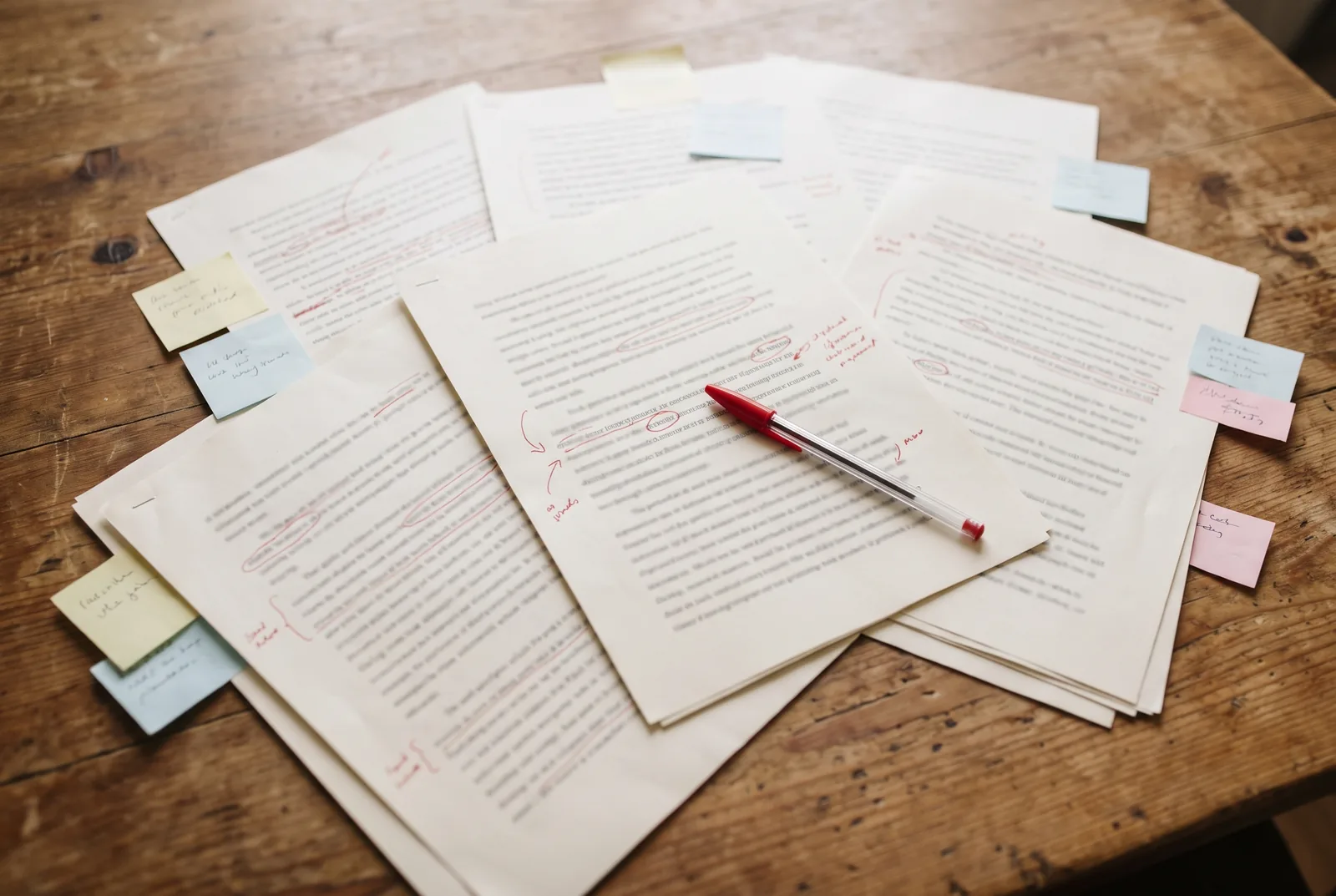
Put the draft away for two weeks, then read it straight through as a reader would, making notes but no edits. Then revise in separate passes, biggest problems first, so you do not polish sentences in a chapter you later cut.
- 1
Structure
Does the order work? Cut, merge or move chapters. Fix the plot holes and the arguments that do not hold.
- 2
Chapters and scenes
Does each chapter earn its place and end with a reason to keep reading?
- 3
Sentences
Trim repetition, filler words and long paragraphs. Read dialogue aloud.
- 4
Proofreading
Spelling, names, dates and punctuation, ideally on a printed copy or a different screen.
Step 6: Get outside readers
You cannot see your own book clearly any more, so borrow other eyes. Beta readers who enjoy your genre tell you where they got bored or confused. Ask specific questions ("where did you put it down?") rather than "did you like it?". If you can afford one, a developmental editor looks at structure, and a copyeditor at sentences and consistency. Make the changes that several readers agree on.
Step 7: Publish the book
Self-publishing on Amazon KDP takes three things beyond the manuscript: a formatted interior at a KDP trim size, a cover sized to your page count, and a listing with a description and keywords. Paperbacks also need an ISBN; our guide to the ISBN for self-published books explains the free KDP number versus buying your own.
For the formatting and cover, an AI book generator can lay out the interior, build the wrap cover and export a Kindle file from your manuscript, so you are not wrestling with page margins in a word processor.

Tools that help you write a book
You need less software than you think: something to write in, somewhere to keep notes, and a way to back up your files. Beyond that, a few tools help at specific stages.
- Short fiction first: if a whole novel feels too big, try an AI story generator to explore a premise as a short story or a picture book before you commit.
- Drafting long books: an AI book writer keeps your outline and reference sheet in view across every chapter and lets you rewrite one chapter at a time.
- Titles: when you need a working title, a free book title generator gives you options by genre.
Frequently asked questions
How long does it take to write a book?
Part time, most first books take six months to a year from idea to finished draft, and another two to four months to revise and publish. At 500 words every day, a 60,000-word draft takes about four months.
How many words is a book?
A novel is usually 70,000 to 90,000 words, a memoir 60,000 to 80,000 and a short nonfiction guide 25,000 to 50,000. Picture books are under 1,000 words.
How do I start writing a book with no experience?
Write a two-sentence premise, outline the chapters one line each, and set a small daily word count you can keep. Then write the first draft without editing. Experience comes from finishing.
Should I outline or just start writing?
Either works, but first-time authors finish more often with at least a loose outline: a list of chapters and what changes in each.
Can I write a book with AI?
Yes, as long as you make the decisions and edit the result. KDP asks you to disclose AI-generated text. See our guide on writing a book with AI for a workflow that keeps your voice.
Do I need an agent or a publisher?
Not to publish. You can self-publish on Amazon KDP for free. An agent matters only if you want a traditional publishing deal.